The Best Soccer Team in the World: Greatest Football Clubs of All Time
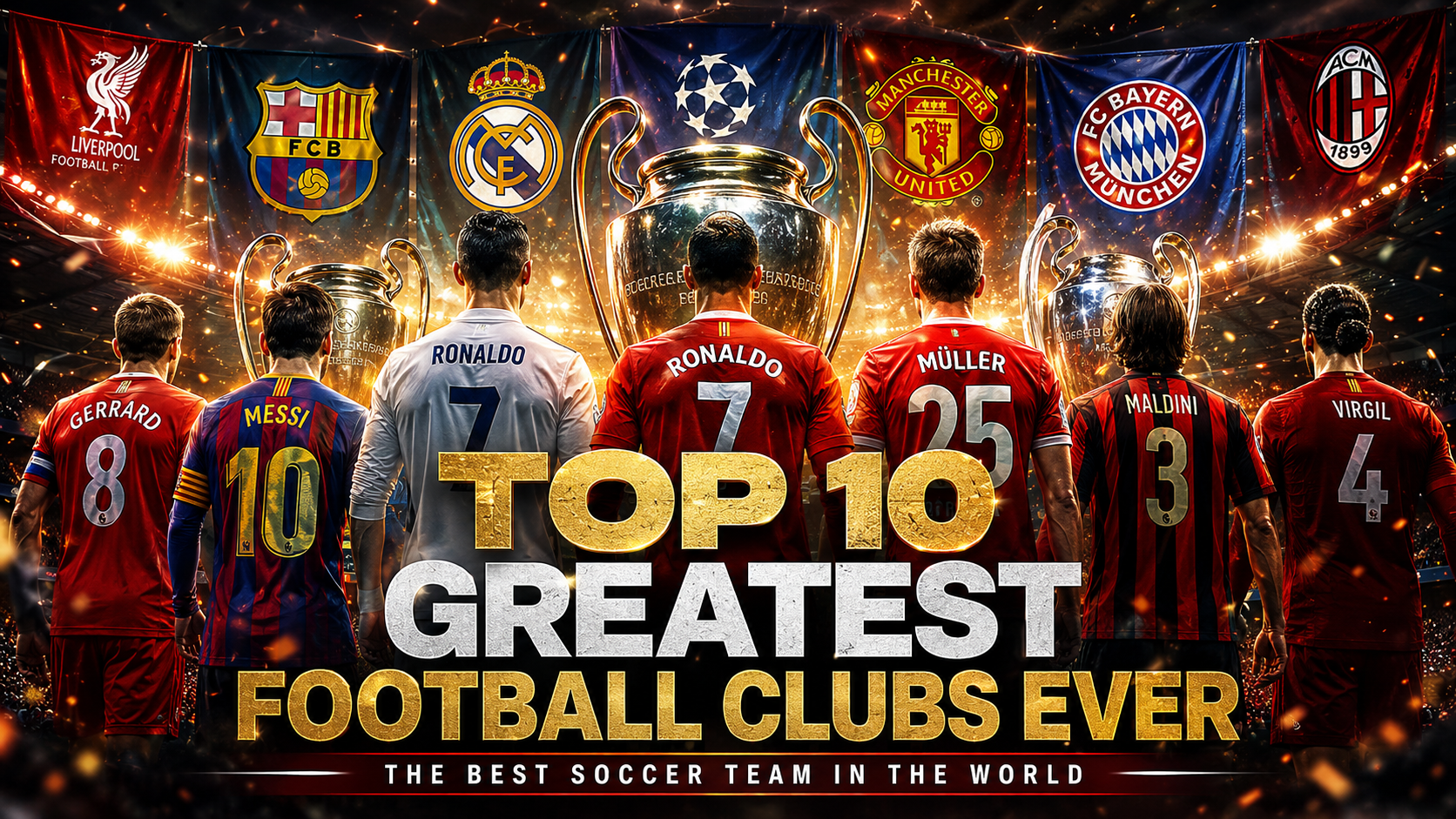
The Best Soccer Team in the World: Ranking the 10 Greatest Football Clubs of All Time
I’ve been watching football for over 30 years. I’ve sat through heartbreaking finals, celebrated ridiculous last-minute winners, and argued in pubs, living rooms, and comment sections about who the greatest teams ever assembled truly were. And I’ll tell you something — that debate never gets old. The question of who is the best soccer team in the world isn’t just a sports argument. It’s a conversation about culture, history, obsession, and what it means to build something that lasts. Lamine Yamal vs Harry Kane Who Is Better?
This list covers ten clubs that didn’t just win trophies — they changed what football looked like. Some dominated for decades. Some produced a single era so breathtaking that the sport still talks about it now. A few built dynasties so powerful that rival fans resented them and their own fans worshipped them. Not all of them are active right now. But every single one of them, at their peak, was the most feared name in world football.
Let’s get into it.
1. Real Madrid — The Club That Owns European Football: Best Soccer Team in the World
Years of Dominance: 1956–present
If you want to argue about the best soccer team in the world, every serious conversation starts here. Real Madrid have won 15 UEFA Champions League titles — more than any other club in history, and not by a small margin. The next closest is AC Milan with seven. That gap tells you everything. Lamine Yamal vs Mbappé Who Is Actually Better?
The first chapter of Madrid’s greatness came in the late 1950s when they won the European Cup five consecutive times — a record that remains untouched. That team featured Alfredo Di Stéfano, arguably the most complete footballer the world had seen at that point, and Ferenc Puskás, who could score from angles that shouldn’t have existed. Together, they made the Bernabéu feel like an arena where normal football laws didn’t apply.
Then came Galácticos. Zinedine Zidane, Ronaldo, Figo, Roberto Carlos, Raúl — Madrid turned their transfer policy into a spectacle, signed the best players on the planet, and won La Liga and the Champions League while doing it in a style that made neutrals stop and watch.
The defining moment? Zidane’s volley in the 2002 Champions League final against Bayer Leverkusen. Left foot. Half-volley. Dropping out of the sky. If you haven’t seen it, go watch it right now. It remains the single most technically perfect goal scored in a European final, and it came in the biggest match of the year. That’s Real Madrid in one moment.
And then they did it again in the 2010s — winning four Champions Leagues in five years with Cristiano Ronaldo, Luka Modrić, and Sergio Ramos. Real Madrid don’t just build great teams. They build great eras.
2. FC Barcelona — The Club That Made Football Beautiful
Years of Dominance: 1992–2015
Barcelona’s greatness isn’t just about trophies, though the trophies are extraordinary. It’s about a philosophy. Johan Cruyff built something at the Camp Nou in the early 1990s called the Dream Team — a side built on possession, pressing, and positional intelligence that felt like a university course in football aesthetics. Pep Guardiola played in that team. He then returned as manager and turned its principles into the greatest club side most of us have ever seen. World Cup 2026 Match Schedule & Stadiums
The 2008–2012 Barcelona team under Guardiola might be the most dominant club team in modern soccer history. In 2009, they won the treble — La Liga, Copa del Rey, and the Champions League — playing football that opposition managers admitted they had no answer for. Xavi, Iniesta, and Lionel Messi formed a midfield and forward line that dissected teams the way surgeons work, precisely and without mercy.
Messi’s solo goal against Getafe in 2007 — a carbon copy of Diego Maradona’s 1986 World Cup goal against England — announced to the world that something genuinely special was happening in Catalonia. By 2012, Messi had scored 91 goals in a calendar year, a record that may honestly never be broken.
Barcelona’s identity — Més que un club, more than a club — gave their football a meaning beyond sport. That emotional weight, combined with the most technically gifted generation of Spanish players in history, made them the best soccer team in the world for a sustained stretch that the sport won’t see again for a long time.
3. Bayern Munich — Germany’s Relentless Winning Machine
Years of Dominance: 1972–present
Bayern Munich have won the Bundesliga 33 times. Thirty-three. That’s not dominance — that’s complete and total occupation of an entire league. Bayern have been so consistently excellent for so long that German football has almost been shaped around them, with rival clubs forced to define themselves by what they’re not rather than what they are.
The 1974 team — featuring Franz Beckenbauer, Gerd Müller, and Sepp Maier — won three consecutive European Cups and gave Germany its footballing identity. Beckenbauer invented the idea of the attacking sweeper, a libero who could glide out of defence and drive forward like a midfielder. It was revolutionary, and it worked.
Then came the 2019/20 season. Under Hansi Flick, Bayern won the Champions League in a final against PSG with a squad featuring Robert Lewandowski, Thomas Müller, Serge Gnabry, and Manuel Neuer — and didn’t lose a single knockout match. Lewandowski scored 55 goals across all competitions that season. The football was relentless, high-intensity, and brutally effective.
What makes Bayern different from most dominant clubs is the consistency. They don’t have peak eras with gaps in between. They have been, essentially, Germany’s best team in every decade since the 1970s. That kind of sustained excellence across 50 years puts them right at the top of any conversation about the most successful soccer teams in history.
4. Ajax Amsterdam — The Small Club That Changed Everything: Best Soccer Team in the World
Years of Dominance: 1965–1973, 1994–1995
Ajax Amsterdam have no right to be on this list by modern financial standards. The Netherlands is not one of football’s superpower leagues. Amsterdam is not a city that global superstars typically migrate to for big contracts. And yet Ajax changed the way the world plays football so fundamentally that their influence is visible in every top team on this planet right now.
Rinus Michels invented Total Football at Ajax in the late 1960s — a system where every outfield player could play every position, where the team pressed as a unit and attacked as a unit and defended as a unit. It was football as philosophy, and it worked. Ajax won three consecutive European Cups from 1971 to 1973. Johan Cruyff was the architect on the pitch, a footballer so ahead of his time that the sport named a specific piece of skill after him.
Then came 1994/95. A young, relatively unknown Ajax side — featuring a 17-year-old Patrick Kluivert, Edwin van der Sar in goal, and Clarence Seedorf in midfield — won the Champions League, beating AC Milan in the final. They built that team almost entirely from their academy. No superstar signings, no billion-euro transfers. Just a system, a philosophy, and belief.
That remains one of the great football stories. And the Ajax system — the Cruyff-Michels philosophy of positional play — was what Guardiola studied, adapted, and turned into the modern version of beautiful football at Barcelona and Bayern. Every tiki-taka pass, every high press, every third-man run you see in elite football today has a thread that runs back to a canal in Amsterdam. That’s a legacy worth celebrating.
5. AC Milan — The Club That Built a Dynasty on Intelligence
Years of Dominance: 1988–1994, 2002–2007
AC Milan’s late 1980s team under Arrigo Sacchi is studied in football coaching courses around the world to this day. It wasn’t just that they won — it was that they changed the way teams defended. Sacchi introduced the flat back four, coordinated pressing, and a tactical discipline that had never been seen at that level before. He did it without a single world-class foreign signing in his first season. His Milan won two consecutive European Cups in 1989 and 1990.
The squad that won those titles was extraordinary. Marco van Basten, the most complete centre-forward of his generation. Frank Rijkaard, the perfect box-to-box midfielder. Ruud Gullit, a player of such physical and technical gifts that coaches still struggle to categorize him. And behind them all, Paolo Maldini — a defender so elegant and so positionally intelligent that he played at the highest level until he was 40.
Milan’s 2007 Champions League final win over Liverpool — a rematch of the incredible 2005 final where Liverpool came back from 3-0 down — was their last great European night. Inzaghi scored twice, Dida kept Liverpool out, and Milan had their revenge. It was the closing chapter of one of the great European dynasties in soccer history.
6. Liverpool FC — The English Club Built on Emotion and Belief
Years of Dominance: 1976–1990, 2018–2020
Liverpool have won 19 English league titles and 6 European Cups — a record among English clubs that no one else comes close to matching. But honestly, the numbers don’t capture what Liverpool actually are. Liverpool are a feeling. Walking out at Anfield with 55,000 people singing You’ll Never Walk Alone before kickoff is one of the most overwhelming experiences in world sport, and it has broken opposition teams mentally before the first whistle blows.
Bob Paisley built the 1970s and 1980s Liverpool sides that won everything in sight — three European Cups, six league titles in eight years, a club so dominant that other English teams of the era simply accepted them as the standard and tried to get close. Kenny Dalglish, Graeme Souness, Alan Hansen, Ian Rush — a generation of players who understood exactly what the red shirt meant. Messi vs Ronaldo Who Is Better?
Then came Jürgen Klopp. If Paisley built the original dynasty, Klopp rebuilt it from the emotional foundations up. His Gegenpressing style — furious, high-energy, relentless — turned Liverpool back into the most exciting team in Europe. The 2018/19 Champions League run, where Liverpool beat Barcelona 4-0 at Anfield after losing the first leg 3-0, then beat Tottenham in the final in Madrid, was one of the great football stories of modern times. Klopp’s Liverpool won the Champions League, Premier League, FA Cup, and League Cup — a feat that placed them firmly back among the best soccer teams in the world.
7. Brazil National Team — The Nation That Plays Football Like Art
Years of Dominance: 1958–1970, 1994, 2002
Brazil are the only team in history to have won the FIFA World Cup five times. They’ve qualified for every single World Cup ever held — 22 consecutive tournaments. No other country on earth can say that. And beyond the statistics, Brazil gave the world a style of football — jogo bonito, the beautiful game — that made people who had no interest in sport stop and watch. Lamine Yamal vs Haaland Who Is Better?
The 1970 Brazil team is widely considered the greatest international football team ever assembled. Pelé, Jairzinho, Rivelino, Tostão, Gérson — a squad of such individual brilliance that their team play felt almost effortless, like eleven artists who happened to also be elite athletes. Jairzinho scored in every single match of that World Cup. Pelé, at 29, was at the absolute peak of his powers. Their 4-1 demolition of Italy in the final is still shown in football coaching sessions as a masterclass in attacking football.
The 2002 team brought a different kind of greatness — Ronaldo’s personal story of recovery from illness and seizure to top-scoring at a World Cup is one of sport’s truly remarkable narratives. Brazil swept through that tournament, beat Germany in the final, and Ronaldo scored twice. It was a fairy tale written in real time.
8. Manchester United — The Club That Never Accepted Second Place
Years of Dominance: 1993–2009
Sir Alex Ferguson managed Manchester United for 26 years, won 13 Premier League titles, and built three or four genuinely different championship-winning teams within that single managerial reign. That’s extraordinary. Most clubs would consider one title-winning team a generational achievement. Ferguson produced multiple ones while wearing the same touchline coat.
The 1999 treble — Premier League, FA Cup, Champions League — is still the defining achievement in English club football history. United won the Champions League final against Bayern Munich with two goals in injury time, scored by Teddy Sheringham and Ole Gunnar Solskjær. Bayern had dominated the match. United were losing with seconds remaining. Then they scored twice in the 91st and 93rd minutes. Peter Schmeichel, the goalkeeper, was in tears. Ferguson stood in the technical area looking like a man watching something he had willed into existence.
The team that won that trophy — Schmeichel, Keane, Beckham, Cole, Giggs, Yorke — was one of the most genuinely complete club sides English football has ever produced. And they weren’t even the most talented United team Ferguson built. The 2007/08 side, featuring a 23-year-old Cristiano Ronaldo at his physical and technical peak, was something else entirely. Ronaldo scored 42 goals that season. United won the Premier League and the Champions League. It was the last great era of English club football’s global dominance.
9. Juventus — The Machine That Made Italian Football What It Is
Years of Dominance: 1977–1986, 2012–2019
Juventus have won Italy’s Serie A a staggering 36 times. More than any club in Italian football history, and by a considerable distance. They’ve won the European Cup twice and reached finals they should have won multiple times in between. The Juventus story is one of relentless, methodical accumulation — not always beautiful, but nearly always effective.
The 1980s Juventus team was something special. Michel Platini, the French midfielder who won three consecutive Ballon d’Or awards while playing in Turin, was the creative heart of a team that also featured Zbigniew Boniek, Marco Tardelli, and Dino Zoff in goal at the age of 40. They won the European Cup in 1985, making them the only club to have won all three major UEFA club competitions at that point.
The 2012–2019 run of nine consecutive Serie A titles — a feat simply never matched anywhere in major European football — rebuilt Juventus as one of the most dominant domestic forces in soccer history. Signing Cristiano Ronaldo in 2018 was the statement moment of that era. The Champions League eluded them during this stretch, but domestically, they were simply unchallengeable.
10. Santos FC — The Club That Gave the World Pelé
Years of Dominance: 1961–1968
Santos might be the most important club in soccer history that most casual fans don’t fully know. A team from a port city in Brazil that won two consecutive Copa Libertadores titles — South America’s equivalent of the Champions League — in 1962 and 1963, and did it by playing football that observers described as unlike anything they had ever seen.
The reason was Pelé. Santos built their entire team around him, and he responded by producing seasons of staggering individual output. In one São Paulo state championship, he scored 127 goals in a single season — a number that still seems impossible to process. Santos toured the world, playing exhibition matches across Europe, Africa, and the Americas, often drawing crowds who had come specifically to watch Pelé play. He was, genuinely, a global phenomenon in the 1960s before the concept of global phenomena really existed in sport.
What makes Santos remarkable is that they achieved what they achieved without the financial resources of European giants, without a major league spotlight, and in an era when South American football received almost no international media coverage. They were the best soccer team in the world at their peak simply because no one — not Real Madrid, not Inter Milan, not Benfica — could stop them.
Conclusion
The debate over the best soccer team in the world will never have a final answer — and honestly, that’s exactly why we love football. Every generation gets to watch a team that makes them believe they’ve seen something no one has ever seen before. Real Madrid own the European record books. Barcelona made the beautiful game even more beautiful. Bayern built a dynasty that spans five decades. Brazil gave the world a style of play that became the template for what football could be.
These ten clubs, at their peaks, were the most successful soccer teams their eras produced. They didn’t just win matches — they changed football. They created moments that their sports still talks about. They built identities that millions of fans carry with them as a kind of personal flag.
Which team do you think deserves the top spot? And which club did we leave out that you’d argue should be here? Drop your pick in the comments — this is a debate worth having properly.
FAQ Section
Q: Who is the best soccer team in the world right now in 2025/26?
A: Based on current squad depth, recent trophy hauls, and global impact, Real Madrid and Manchester City are the strongest cases. Madrid’s 15 Champions League titles and current squad make them the historical benchmark, while City’s Premier League dominance under Pep Guardiola makes them the most consistently excellent club of the recent era.
Q: Which soccer team has won the most trophies in history?
A: Real Madrid leads all clubs globally with 15 UEFA Champions League titles. For total combined domestic and European trophies, Barcelona, Bayern Munich, and Juventus are all among the most decorated clubs in soccer history, each with over 50 major honours across their existence.
Q: What is the most successful soccer team in the world by league titles?
A: Juventus hold the record for most domestic league titles in their country with 36 Serie A championships. Bayern Munich lead Germany with 33 Bundesliga titles. Real Madrid and Barcelona both have over 25 La Liga titles each, making Spain’s top division the most contested among elite clubs.
Q: Has any soccer team ever gone unbeaten for an entire season?
A: Arsenal’s 2003/04 Premier League season — the Invincibles — remains the most famous unbeaten campaign in top-flight European soccer history: 38 games, 26 wins, 12 draws, zero defeats. In modern football, going an entire league season unbeaten has not been replicated at that level since, making it one of the sport’s most enduring records.
#Best Soccer Team in the World#Best Soccer Team in the World#Best Soccer Team in the World#Best Soccer Team in the World#Best Soccer Team in the World#Best Soccer Team in the World#Best Soccer Team in the World#Best Soccer Team in the World#Best Soccer Team in the World#Best Soccer Team in the World#Best Soccer Team in the World#Best Soccer Team in the World

3 comments